Skip to content

Vendor Contract Management

Cut contract review time across your vendor portfolio.

Myhanko's AI flags risky deviations up front — so you approve with confidence.

The problem

Vendor contracting is still scattered across disconnected tools.

Risk

Registration in one place, contracts in another

Vendor onboarding lives in a form tool, while the actual contract moves through email and a separate e-sign service.

Risk

Negotiation gets lost in threads

Tracked changes, comments, and approvals scatter across inboxes and documents. Tracking versions is a manual headache.

Risk

Signatures without legal weight

Basic e-signatures may not satisfy jurisdiction-specific digital-signature laws or produce a defensible audit trail.

Risk

No single reliable record

Conflicting information between vendor records, contract drafts, and signed documents creates risk and rework.

The solution

One platform for vendor registration and the full contract lifecycle.

Myhanko connects vendor onboarding, contract generation, negotiation, approval, and native PKI signing — so every participant works from the same record.

1) Vendor registers once

Vendors complete registration online and upload the documents your deployment requires. Their email becomes their identity across every future contract.

2) Contract is generated from truth

Form data and uploaded documents fill a document template to produce the draft. An admin reviews before it is marked Generated.

3) Negotiate, approve, and sign

Amendments follow a per-contract route with tracked changes. Approvers sign off, then signers apply native PKI signatures bound to certificates.

What it is not: A generic e-sign point solution or a separate vendor database. Myhanko is end-to-end vendor and contract lifecycle management.

How it works

The contract lifecycle, from start to finish.

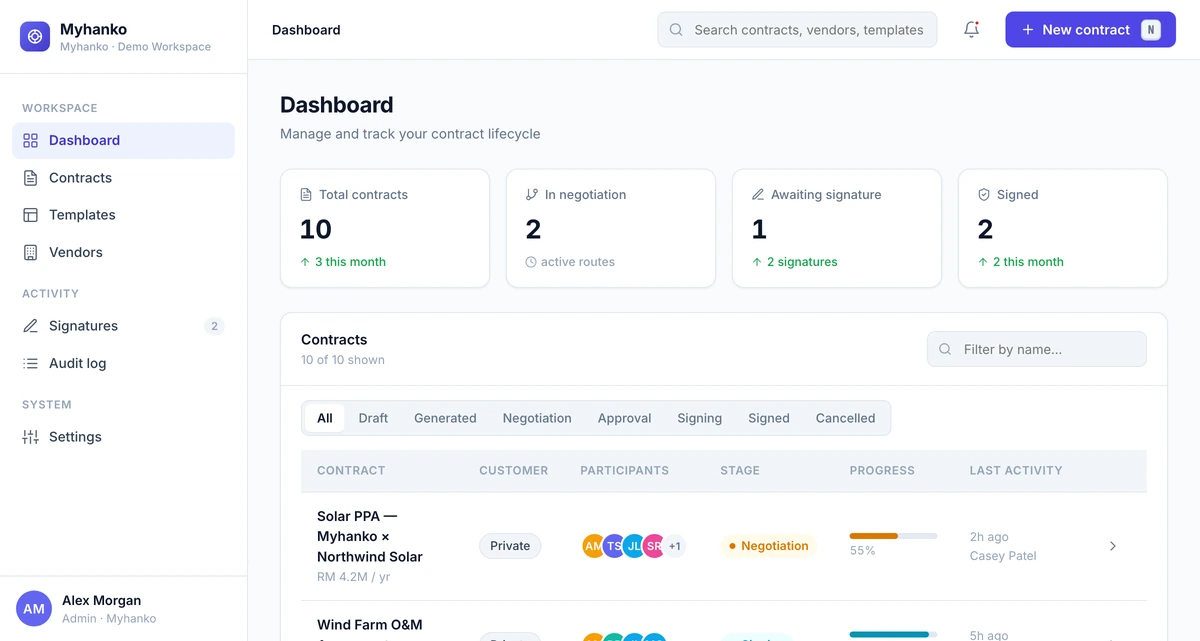
Create the contract, invite authors and signers, generate from form data and exhibits, negotiate in a route, approve, and sign with PKI-backed signatures.

Create the contract

An admin creates the contract with customer and vendor categories, adds participants by email, and assigns contract roles: author, signer, viewer, or approver.

Fill and generate

Authors fill forms and upload documents at the same time. The system generates a draft from the template; an admin reviews and marks it Generated.

What the platform handles at each stage:

Vendor onboarding

Self-service registration with deployment-specific categories and required documents. Status is tracked from submission through approval.

Contract generation

Template blanks are filled from form answers; uploaded documents become exhibits. Generation is admin-reviewed, never autonomous.

Negotiation & signing

Participants amend in a defined route; every change is tracked. Approvers sign off, then signers apply PKI signatures verified by a one-time code.

Use cases

Common contract types the platform supports

Vendor supply agreements

Multi-party supply contracts with defined negotiation routes and exhibits.

Renewable energy PPAs

Configured for renewable-energy party categories and compliance.

Service & consulting contracts

Standardized templates with role-based author, approver, and signer paths.

Amendments & renewals

Re-negotiation flows triggered by rejection or a new amendment request.

AI risk analysis

See every risky deviation before legal review.

Myhanko's AI reads every deviated clause against your approved template, rates the risk, and suggests fixes — so your team de-risks the contract before it reaches legal review.

  • An overall risk rating — low, medium, or high — at a glance.
  • A clause-by-clause breakdown of where the contract deviates from your approved template.
  • AI-suggested remediation, clearly labelled for human review.
  • A live countdown to your approval deadline.

Advisory only — AI flags risk and suggests fixes; it never edits a contract, never approves a deviation, and never replaces legal review. Your team decides.

Safety & oversight

For the contracts you can't afford to get wrong.

Myhanko combines the convenience of cloud software with the controls multi-party contracts demand: human approval gates, an audit history that can't be changed, and PKI-backed signatures.

  • Native PKI e-signing

    Signatures are bound to certificates from a certificate authority of your choice — licensed under your jurisdiction's digital-signature law in production, or a demo certificate for testing.

  • Human oversight

    Generation is admin-reviewed, negotiation follows a route, and approvals are explicit. The platform never submits or signs on behalf of a human.

  • Tamper-evident audit trail

    Every transition, amendment, approval, and signature is logged with email, timestamp, IP address, a one-time code, and a document fingerprint.

Pilot path

Start with one contract category.

We configure your first deployment, set up categories and templates, onboard your pilot vendors, and prove the lifecycle before expanding.

  • First contract category live in 2–3 weeks
  • Deployment-specific templates, fields, and document types
  • PKI signing configured for your jurisdiction
01

Map categories & templates

Define vendor categories, customer categories, form templates, and required documents.

02

Configure the platform

Set roles, negotiation routes, approval points, and the signing certificate authority for your jurisdiction.

03

Pilot with real contracts

Run a live contract end-to-end with your team and a pilot vendor; verify audit trail and signatures.

04

Expand

Roll out additional categories, users, and integrations once value is proven.

FAQ

Questions we hear before every deployment.

Basic e-signatures capture a visual signature. PKI digital signatures securely link the signer to the document using a certificate from a certificate authority. Myhanko supports a certificate authority of your choice: a licensed authority under your jurisdiction's digital-signature law in production, or a demo certificate for testing.

Yes. A contract can have multiple authors filling forms and uploading files at the same time, multiple participants amending clauses in a defined negotiation route, and multiple signers applying PKI signatures. Every action is tied to the participant's email identity.

Each contract has a per-contract negotiation route: an ordered list of participants who amend the contract in turn. Amendments are recorded as tracked changes. Rejection during approval or signing returns the contract to negotiation.

Every lifecycle transition, form edit, file upload, amendment, approval, and signature is logged with the participant's email, timestamp, IP address, a one-time code, and a document fingerprint. The trail can't be changed once recorded.

Vendor categories, customer categories, form templates, required document types, and the certificate authority are configured per deployment. The core product stays generic, so the same platform can serve different industries and compliance regimes.

Email is identity. Users sign in with their email address and a one-time code sent to their inbox. The same email and one-time code verifies a signer before they apply a signature. No separate passwords to manage.

First contract category and a pilot vendor are typically live in 2–3 weeks. We scope categories, templates, document types, and the signing certificate authority during the initial configuration call.

Get started

Let's see how Myhanko fits your workflow.

Book a 30-minute call. We'll map your vendor and contract lifecycle, then propose a pilot configuration.

or email us at ceo@myhanko.ai — no long-term commitment required to start the pilot.